House Rules: Confirming Freedom vs. Restrictions
Compared to flat-sharing in the West, Japanese share houses tend to have much stricter, more detailed rules. While this is intended to maintain “harmony” (wa), it can be a major source of stress if it doesn’t align with your lifestyle.
Guest Policy: Overnight Stays and Access
One of the most common sources of friction is whether friends or partners are allowed inside the property.
Some rules might remind you of a college dorm; in fact, the vast majority of share houses in Japan prohibit friends or partners from staying overnight, even in private rooms.
Many properties have rules such as “Guests only allowed in the living room until 10 PM” or “Overnight stays require advance application.” If staying over is permitted, expect an additional fee of roughly ¥1,500 ($9) to ¥3,000 ($19) per night. If you plan on having guests frequently, your monthly expenses will skyrocket if you don’t account for this beforehand.
Be sure to clarify these restrictions before signing.
While inconvenient, there are understandable reasons regarding security and costs. From a security standpoint, it ensures no strangers enter the premises. Regarding costs, most Japanese share houses have a fixed monthly utility fee. If a guest stays long-term, the management company has to shoulder the extra electricity for AC and gas for showers.
In Japan, these rules are almost non-negotiable. If you find them unacceptable, you might be better off renting a standard private apartment.
Music and Noise Regulations
While musical instruments are generally a “No” in most properties, check if there are specific time restrictions even for digital pianos or acoustic guitars.
If you don’t play instruments and value peace and quiet, avoid “musical-friendly” properties. These houses attract music lovers, and silence will be hard to find.
Also, restrictions on using washing machines or hair dryers late at night (e.g., prohibited after midnight) can be a deal-breaker for night owls. Some of these rules might seem micro-managed to foreigners, but they are common in Japan—so always double-check.
Smoking Policy Details
Most modern share houses in Japan are strictly “No Smoking.”
Even if you think “in my room” or “on the balcony” is fine, it is often prohibited to prevent odors, staining, and neighbor complaints. If you smoke, check if there is a designated smoking area on-site, and whether it’s inside the building or requires walking off the premises.
Waste Management and Language Support
It’s no exaggeration to say Japan’s trash-sorting system is one of the most complex in the world. Always confirm who takes the trash to the outdoor collection point (a cleaning service or a resident rotation/duty). In houses with many international residents, check if there are multilingual manuals (English, Chinese, Korean, etc.) posted in the trash area. A messy trash area is a huge red flag for pest risks (like cockroaches) in the summer.
Cleaning Regulations
Similar to trash disposal, you must confirm who is responsible for cleaning the common areas.
In medium-to-large properties managed by major companies, professional cleaners usually handle this. However, in smaller houses (10 residents or fewer), cleaning is often self-managed via a rotation system among residents.
Personally, I recommend avoiding “self-managed” properties, as they are frequently the root of disputes over cleaning standards.
Facilities: Checking Convenience Through Hardware
Properties often look beautiful in photos but may be aging or poorly designed in reality. Use all your senses to verify the space.
Plumbing: The “Sniff” and “Mold” Test
During your viewing, always check the shower room and kitchen drains. If it smells like sewage, walk away. A clogged or smelly drain is proof that regular cleaning is being neglected.
Also, open all cabinets under the sink. Check for a musty or moldy smell. In older Japanese houses where humidity gets trapped easily, mold can ruin your clothes and shoes.
The “Knock” Test for Soundproofing
Even if a room is labeled “private,” if the walls are paper-thin, you have zero privacy.
Most Japanese rooms use gypsum board with wallpaper over it.
Lightly tap the wall share with the neighbor. Does it sound solid, or does it make a hollow “thump-thump” sound like a single sheet of board?
A solid sound is 100 points, but honestly, since very few share houses use concrete interior walls, you may need to compromise here to some extent.
Pay attention to the door as well. Many share houses are created by partitioning a larger room. In these cases, the door might be a lightweight interior wooden door rather than a heavy-duty one. If there is a large gap at the bottom of the door, sound will leak significantly.
Private Room Specs and the Truth About “Size”
The Japanese unit “Jo” (tatami mat count) can be confusing, so focus on the “actual flow” of the room. Check if the storage is deep enough for a suitcase and if power outlets are near the head of the bed or desk. Also, if you don’t need the provided furniture, some places charge a removal fee of ¥3,000 ($19) to ¥5,000 ($31), so confirm this in advance.

Plumbing Ratios and Laundry Specs
Check if the number of showers, toilets, and washing machines is sufficient for the number of residents. A good rule of thumb is 1 per 5–8 people. Pay special attention to “Pay-as-you-go laundry.”
Many places use coin-operated machines, costing ¥100 ($1) to ¥200 ($1) per load. This can add several thousand yen to your monthly budget. However, this is common in larger properties, so it might be worth a compromise if the rest of the house is great.
Wi-Fi and AC Condition
During the viewing, ask to connect your phone to the Wi-Fi and run a speed test. If the speed can’t handle video streaming, remote work and entertainment will be impossible.
Also, check if the air conditioner is a relatively new model. Though rare, some properties use individual meters rather than a fixed utility rate. In those cases, electricity can cost ¥5,000 ($31) to ¥10,000 ($63) in the summer, so an energy-efficient, newer AC is essential.
Security and Mail/Deliveries
Check if the lock is a smart lock or a physical key. Losing a physical key in Japan can cost ¥20,000 ($125) or more for a replacement. If you order from Amazon frequently, check for the presence of delivery lockers (Takuhai Box) and see if they are being left full and neglected.
Residents: Community Vibes and Compatibility
“Who you live with” is the most important factor in share house life.
If possible, try to talk to a resident during your viewing and ask how they like living there. Even if you don’t meet anyone, you can predict the reality from the “traces” they leave behind.
Profiling Residents via the Entryway “Shoes”
In smaller houses or converted houses where you remove your shoes at the entrance, look at the shoes on the rack. A lot of dress shoes and pumps suggest professionals with regular schedules. Flashy sneakers or sandals suggest more students or freelancers. Also, if the “limit of 2 pairs per person” rule is being ignored, other house rules are likely being neglected as well.
The Living Room “Clutter” Test
Are dirty dishes left in the sink? Is personal clutter left all over the living room table? If this is the norm, it’s a sign that either the management company isn’t doing its job or the residents have poor manners.
Ask Staff About the Community “Temperature”
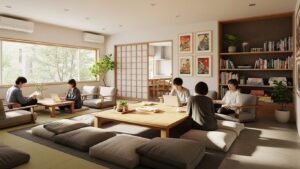
Ask, “What time do people usually gather in the living room?” or “Are there regular parties?” If you want social interaction but no one ever uses the common area, you’ll feel lonely. Conversely, if you want quiet but there are parties every night, it will be a nightmare. Be clear about what you want.
The Quality of Warning Notices
The bulletin board is a mirror of the house’s “public order.” If there are many aggressive signs saying “No Noise” or “Clean the Kitchen,” it means trouble is frequent. Also, if a six-month-old notice is still hanging there, it’s a sign that management doesn’t visit the property regularly.
Surroundings and Moving Out: Don’t Forget the Exterior
Even if the house is perfect, outside stressors can make it unbearable.
Nighttime Safety and Convenience
Actually walk from the nearest station to the property. Are there streetlights? Does it feel safe to walk alone at night? Also, check for 24-hour convenience stores or affordable supermarkets within walking distance—essential for saving money in Japan. Japan has many great spots for solo dining; the more there are nearby, the more comfortable your life will be.
Move-out Settlement Rules (Important)
Before signing, always confirm the “Cleaning Fee” for when you move out. In many cases, ¥20,000 ($125) to ¥40,000 ($251) is deducted from your deposit or billed separately. Make sure this amount is reasonable and clearly record the conditions for a refund (such as how many months’ notice is required).
Conclusion: Make an Informed Decision
Once the viewing is over, don’t decide on the spot. Go to a cafe and review this list. If you felt even a slight “off-smell” or the management staff was vague in their answers, have the courage to look at other properties. A great new life in Japan begins with choosing a home you are truly satisfied with.