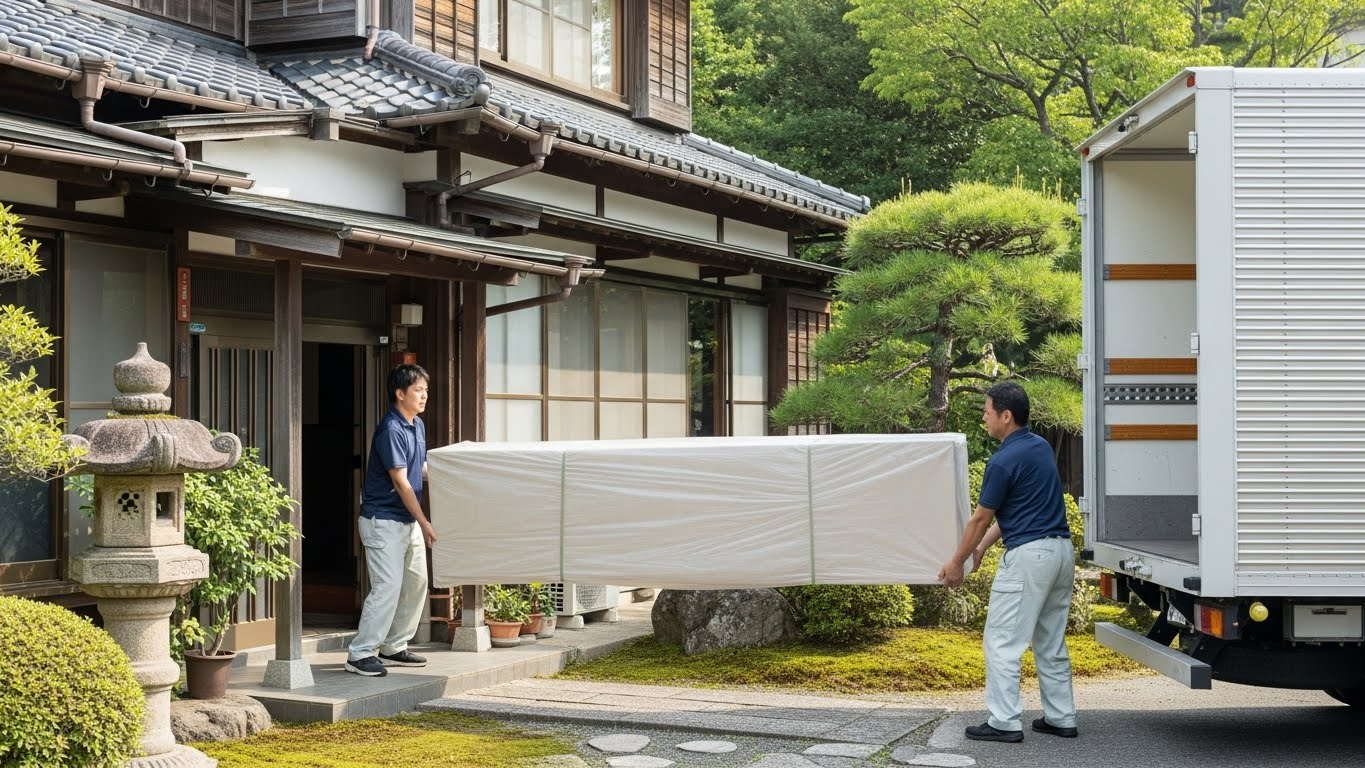
In Japan, it’s common knowledge that “moving is expensive.” For foreign residents in particular, quotes from Japanese moving companies can sometimes equal several months’ rent, leading to “eye-popping” prices that are frankly shocking.
However, if you use a little strategy, you can slash these costs dramatically.
As a local Japanese resident, I’m here to help you navigate your best options from a local’s perspective. In this article, I’ll even introduce the option of moving entirely by yourself—starting with the mindset of “not hiring a moving company at all.”
The key lies in two axes: “Distance” and “Volume.”
This guide categorizes your situation into four quadrants and explains the “cheapest way to finish the job” for each case. Before you pick up the phone to call a mover, read this first and choose the strategy that fits you best.
The Strategy Matrix
First, check the table below to see which category you fall into.
| Volume \ Distance | Short Distance Within 1–2 hours by car (e.g., within Tokyo’s 23 wards, Tokyo ⇔ Yokohama) |
Long Distance Over 2 hours by car / Shinkansen (e.g., Tokyo ⇔ Osaka, Tokyo ⇔ Fukuoka) |
|---|---|---|
| Large Cargo Includes furniture/appliances (Fridge, bed, washing machine, etc.) |
【A: DIY / Light Freight】
|
【B: Professional Services】
|
| Small Cargo Cardboard boxes & suitcases only (No large furniture) |
【C: Minimalist Move】
|
【D: Declutter & Mail】
|
Note: “Large Cargo” here refers to furniture for 1–2 people, such as a medium-sized refrigerator. If you have large family-sized fridges, sofas, or heavy shelving, please hire professional movers for your safety.
【A】Short Distance × Large Cargo
Target: Moving within the same city or to an adjacent prefecture with large items like beds or fridges.
In this case, you should avoid the big-name movers (like Sakai or Art). Their prices include “long-distance truck maintenance” and “advertising costs,” making them way too expensive for local moves. The right answer here is “DIY” or “Private Light Freight.”
1. Rent a Van (DIY Move)
If you can drive or have friends to help, this is the absolute cheapest.
-
- Choosing the Vehicle:
- Hiace / Caravan: The gold standard. For a single person’s belongings, it easily fits a fridge and washing machine.
- Kei-truck: A good option if you have less gear and it’s not raining, but you’ll need skills with tie-down ropes for the open bed.
- Cost Estimate:
- Rental fee (12 hours): Approx. ¥10,000 ($63) – ¥15,000 ($94)
- Gasoline: Approx. ¥1,000 ($6) – ¥2,000 ($13)
- Total: Approx. ¥15,000 ($94)
- Choosing the Vehicle:
・Cheap
・Total freedom of schedule.
・Can be a fun “event” if working with friends.
・License: You need a Japanese license valid for the vehicle or a valid International Driving Permit (IDP).
・Securing Cargo: If the van isn’t packed tight, you’ll need to secure heavy items with ropes/straps.
・Heavy Lifting: Moving fridges and washers is dangerous for amateurs. Scuffing walls or floors risks high repair fees when you move out.
・Return Trip: You usually have to return the car to the original shop (One-way rentals exist but are pricey).
2. Using Akabou (Red Cap)
This is the ultimate, uniquely Japanese moving hack.
Akabou is a cooperative of independent owner-operators with light trucks. Because they don’t have the rigid manuals of big corporations, they are flexible and incredibly cheap.
- Service Features:
- You get one light truck and one driver.
- Important: The driver will help carry things, but they are “assistance.” You are expected to carry items alongside them.
- Cost Estimate:
- For 2 hours / within 20km: Approx. ¥6,000 ($38) – ¥8,000 ($50)
- While there are extensions and distance fees, most moves within Tokyo stay under ¥15,000 ($94).
- How to Book:
- Search “Akabou [Your Area Name]” and call a local office. Since English support is rare, it’s best to ask a Japanese-speaking friend to help.
・No driver’s license needed.
・You don’t have to drive on unfamiliar Japanese roads.
・Many drivers don’t speak English (it’s a freelance coop, so service varies by office).
・Important: They are technically “transporters,” not “movers.” Often, they only move things from entrance to entrance (they may not carry items into specific rooms). Confirm this to avoid trouble!
Many Akabou drivers will let you ride in the passenger seat to the new place. This saves you the train fare! However, always ask “Can I ride with you?” (Doujou kanou desu ka?) when booking. Since COVID, some may refuse. They will almost certainly refuse if:
・The distance exceeds 50km
・You need to use the highway
【B】Short Distance × Small Cargo
Target: People moving between share houses, moving into furnished apartments, or minimalists. You only have suitcases and a few boxes.
Spending big money here is nonsense. The point is to treat this as an “extension of daily travel.”
1. Rental Car (Compact Car)
If your gear fits in a subcompact or compact car (Fit, Vitz, etc.), there’s no need for a van.
- Cost: Approx. ¥5,000 ($31) – ¥7,000 ($44) for 6–12 hours.
・Cheap
・Move whenever you want without coordinating with a company.
・You or a friend must be able to drive.
2. Taxi Apps (GO / S.RIDE / Uber)
If rental paperwork is a hassle or you don’t have a license, a taxi is perfect. Japanese taxis have surprisingly large trunks and can fit about two large suitcases.
- Aim for the “JPN TAXI”:
- Those tall, black or deep blue taxis you see (TOYOTA JPN TAXI) have spacious interiors and can hold a lot of luggage. You can’t always specify the model in the app, but if you’re hailing one on the street, pick this type.
- Cost:
- Moving a few kilometers within Tokyo costs about ¥2,000 ($13) – ¥4,000 ($25). Sometimes it’s cheaper than a rental. Plus, with first-time user coupons, you might even move for free!
・Zero coordination with movers; move on a whim.
・Cheaper than a rental for very short distances (2–3 stations away).
・If the distance is over 10km, a rental car becomes more cost-effective.
3. The Train Strategy
For minimalists whose life fits in a suitcase, just take the train. This is the 【Cheapest: Just the train fare】 method, but you must be careful not to commit a major etiquette faux pas.
- Rules and Manners:
- Strictly avoid Rush Hour: Never get on a train with huge luggage between 7:30–9:30 AM or 5:30–8:00 PM on weekdays. Not only is it physically impossible, but it will lead to serious friction with other passengers.
- Best Times: Weekday afternoons (11:00 AM – 3:00 PM) or early morning on weekends.
- Split the Trips: Don’t try to carry everything at once. Taking two suitcases today and the rest tomorrow is a smart move.
【C】Long Distance × Large Cargo
Target: Relocating from Tokyo to Osaka, Hokkaido, Fukuoka, etc. You want to bring all your furniture.
This is the “boss level” category that costs the most. A mistake here can cost you over ¥100,000 ($627). Driving a rental long distance is actually usually *more* expensive than pros once you calculate highway tolls, gas, and the “drop-off charge” (one-way fee).
1. Using Moving Companies
Cost: Varies by season/location.
Single: ¥50,000 ($313) – ¥120,000 ($752)
Family: ¥130,000 ($815) – ¥350,000 ($2,193)
Use long-distance pros like Sakai Moving Service or Art Moving Center. These tips apply to Japanese people too—we also struggle to keep these costs down!
- Timing is Everything:
- Strictly avoid March and April. In Japan, the school and fiscal year starts in April, so March is peak moving season. Prices skyrocket and availability vanishes.
- “Aimitsu” (Multiple Quotes) is Life:
- Moving prices in Japan are not fixed; they are negotiated.
- Always get quotes from at least 3 companies.
- The Magic Phrase: “Agent A offered me X yen. If you can beat this, I will sign right now.”
- Specify “Konsai-bin” (Combined Cargo):
- Tell them “My arrival date is flexible.”
- By using a “Combined Shipment” (sharing a large truck with others) or a “Return Trip” (using a truck that would otherwise return empty), you can cut the price nearly in half.
2. Single Person Packs (Tan-shin Pack)
If you have little furniture (fridge, washer, futon, and ~10 boxes), “Single Packs” from companies like Yamato or Art are unbeatable.
- How it works:
- You rent a “Cage Trolley” (Box) roughly 170cm high × 100cm wide. It’s a flat-rate service for whatever fits inside.
- Cost:
- Tokyo to Osaka: Approx. ¥25,000 ($157) – ¥35,000 ($219) per box.
- Pros:
- No home visit for a quote. Book entirely online or by phone.
- Transparent pricing. No fear of “hidden fees.”
- Caution:
- Bed mattresses and large sofas won’t fit. You’ll need to ship those separately or dispose of them.
【D】Long Distance × Small Cargo
Target: Long distance, but no furniture (or you’re willing to ditch it).
This is the smartest, most modern way to move. Japan’s logistics system (Takkyubin) is world-class. You’d be crazy not to use it.
1. The Economics of “Danshari” (Discard Strategy)
For long distances, the cost of shipping old furniture (especially cheap items from IKEA or Nitori) often exceeds the value of the item itself. For example, moving a 3,000 yen bookshelf might take up 5,000 yen worth of “space cost” in a truck.
“Ditch it and buy new locally” is often cheaper overall, and you get new stuff in your new home. If you have a cheap desk or mattress, choosing to throw them away is your best path to saving.
2. Shipping via Takkyubin (Japan Post / Yamato / Sagawa)
Send your clothes, books, and sundries via Takkyubin or Yu-Pack.
- Kuroneko Yamato:
- Prices are determined by the box size (sum of 3 sides).
- Kanto to Kansai for a size 120 (large box) is about ¥1,800 ($11) – ¥2,000 ($13).
- Even sending 10 boxes only costs ¥20,000 ($125). For long distances, this is drastically cheaper than a mover.
- Pro-Tip: Use the “Multiple Parcel Discount”—sending 2+ boxes to the same address gets you a discount.
3. Human Travel via LCC, Train, or Night Bus
Once your boxes are shipped, you are hands-free. Just travel like a tourist!
- Shinkansen: Fast and comfy. Tokyo to Osaka is ~14,000 yen.
- LCC (Low-Cost Carriers): Peach or Jetstar. Book early to fly Tokyo (Narita) to Osaka/Fukuoka/Sapporo for ¥5,000 ($31) – ¥8,000 ($50).
- Night Bus: The absolute budget king. Tokyo to Osaka can be as low as ¥3,000 ($19).
“Hidden Costs” and Saving Tips
Beyond the transport, there are overlooked costs you should optimize.
1. Restoration Costs (Shikikin)
Japanese leases require “restoration to original state” when you leave.
- Security Deposit (Shikikin) Refund: Cleaning the room thoroughly (especially limescale and mold in the kitchen/bath) increases the chance of getting your deposit back.
- Know the “Tokyo Rule”: In some areas like Tokyo, ordinances state that “wear and tear” from normal living is the landlord’s responsibility. If you get an unfair bill, ask: “Is this based on the Tokyo Guidelines?”
2. Switching Infrastructure
- Internet: Check if you’re in a window to cancel without fees. Often, “transferring” your service to a new home comes with free installation campaigns.
- Electricity/Gas: Since deregulation, you can choose your provider. Switching to “Rakuten Denki” or “Looop Denki” during a move can sometimes reduce your base fee to 0 yen.
3. The Oversized Trash Trap
If you realize on moving day that you have extra trash, you’re in trouble. Japan’s trash rules are strict and require advance booking for large items. If you leave trash behind, the management company will charge “outrageous disposal fees.” Start planning your trash disposal 2 weeks in advance!
Conclusion: Which Plan is Yours?
To wrap it up:
- Short distance + Large cargo: “Akabou” or “Rental Van”
Treat a friend to lunch for their help; it’s the best way to save and make a memory. - Short distance + Small cargo: “Taxi” or “Train”
No need to call the pros for a few bags. - Long distance + Large cargo: “Aimitsu” or “Single Pack”
Your negotiation skills will be tested. Call at least 3 companies. - Long distance + Small cargo: “Declutter” + “Mail”
The smartest modern move. Don’t pay high shipping for old furniture.
Moving in Japan is an “information war.” If you go blindly to the big guys, you’ll be overcharged. But with this matrix, you can use the money you saved for new furniture or a celebratory sushi dinner.
Choose wisely and get your new life in Japan off to a great start!