Dramas: Human Relationships Woven Through Communal Living
TV Dramas & Reality Shows
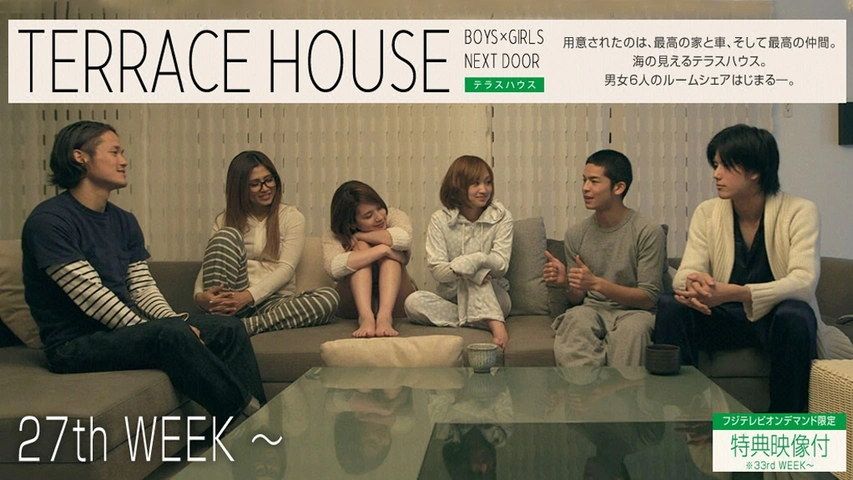
TERRACE HOUSE
This reality show was the definitive catalyst for the Share House boom in modern Japan. As the famous narration goes, “Six strangers are provided with a beautiful house and a beautiful car. There is no script whatsoever.” It captures three men and three women living under one roof in a manner that is both mundane and, at times, incredibly dramatic.
The show’s primary appeal lies in the contrast between the “stylish Share House” setting and the “raw human relationships” that unfold within it. The dynamics unique to a Share House—minor arguments in the kitchen, confessions in the living room, and the cycle of members graduating and new residents joining—captivated viewers.
Crucially, it raised awareness of properties known as “Social Residences,” which feature luxurious common areas, and solidified the image of a Share House as a stylish and exciting way to live among young people.
The Series’ Legacy and Influence
The journey began in Shonan, a beach resort near Tokyo, before moving to Tokyo, Hawaii, and Karuizawa. While the show served as a springboard for many cast members to break into modeling and entertainment, it also sparked significant social debate regarding cyberbullying on social media and the ethics of reality programming.
Although production has ended, the series remains a milestone in Japanese reality television, still discussed by fans today.
| Title | Setting / Location | Broadcast / Release Years | Where to Watch / Links |
|---|---|---|---|
| BOYS × GIRLS NEXT DOOR | Shonan, Kanagawa | 2012 – 2014 | Amazon / FOD |
| BOYS & GIRLS IN THE CITY | Tokyo | 2015 – 2016 | Netflix / FOD |
| ALOHA STATE | Hawaii, USA | 2016 – 2017 | Netflix / FOD |
| OPENING NEW DOORS | Karuizawa, Nagano | 2017 – 2019 | Netflix / FOD |
| TOKYO 2019-2020 | Tokyo | 2019 – 2020 | Netflix / FOD |
*Note: Regarding “Terrace House: TOKYO 2019-2020,” distribution has been suspended on most platforms or limited to specific episodes. This follows the tragic passing of a cast member due to cyberbullying on social media.
Kakafukaka

After failing her job hunt and breaking up with her live-in boyfriend, protagonist Aki Terada is at rock bottom. The story begins when she reunites with her first love from middle school at a Share House and starts a curious life of cohabitation.
This adult love story leverages the “unavoidable proximity” inherent to Share House life. Sharing a kitchen and meeting in the living room—the ambiguous relationship of being former lovers while now being mere housemates—is masterfully portrayed within this closed environment.
The dilemma between maintaining privacy as “others” and the overstepping of boundaries as “housemates” ultimately helps these complicated adults find their way toward self-recovery.
Streaming Platforms
As a local Japanese drama, “Kakafukaka” is available on limited VOD services. However, episodes (excluding 3–6) can be viewed for free on TVer, Japan’s official TV archive site. (Available in Japanese only; VPN required from outside Japan.)
Subtitles in other languages can be found on Viki or Netflix, though availability varies significantly by region. Please check your local listings.
The original source of “Kakafukaka” is a manga, which offers even more depth than the TV adaptation. For those interested, the manga version is highly recommended.
The English version is available on Amazon via Kindle, making it easily accessible.

Why I Dress Up for Love

Kurumi Mashiba works in PR for an interior design company and is a woman who “dresses up” her life. The story kicks off when she unexpectedly ends up moving into a Share House populated by people with entirely different values.
The residents—including a minimalist chef, an online counselor, and an aspiring contemporary artist—coexist in a spacious house in Omotesando. Their lifestyle symbolizes modern concepts like “work-life integration” and the “acceptance of diversity.”
Notably, the interactions in the common areas act as more than just a source of comfort; they serve as a trigger for the protagonist to let go of her rigid outlook. The bonds nurtured through daily chores like cooking and cleaning are perhaps the greatest advantage of Share House living.
- Streaming Platforms: Netflix
Byplayers: If the 6 Supporting Actors Lived in a Share House
 In this mockumentary-style drama, legendary “supporting actors” of the Japanese film industry are tasked by a Chinese streaming site to live together in a Share House for three months to prepare for their roles.
Seeing these seasoned gentlemen divide up housework, bicker over trivial things, and debate acting theory over a shared meal showed the public that a Share House is not just for the young.
The importance of “adhering to rules” and maintaining a “proper distance” in communal living is humorously depicted through the veteran actors’ mature performances. It serves as an excellent model for the older generation considering a Share House as a community.
Unfortunately, as this is a local drama, there are currently no sites streaming it with English subtitles.
- Streaming Platforms: Amazon Prime, U-NEXT
Plage

Based on the novel by Tetsuya Honda, this social human drama sharply highlights the “safety net” aspect of a Share House.
After a lapse in judgment involving drugs, protagonist Takao Yoshimura becomes an ex-convict with nowhere to go, eventually finding his way to the Share House “Plage.” There, he finds others with “baggage”—people who have committed crimes or carry heavy personal secrets.
The layout—a cafe on the first floor and living quarters on the second—is a configuration often seen in real-world concept-based Share Houses. The story makes us contemplate the social significance of the Share House: how an environment where you share meals and respect boundaries without being isolated can help rehabilitate the human spirit.
- Streaming Platforms:Netflix, WOWOW On Demand, Amazon Prime Video, U-NEXT
The Yokai Share House

The story begins when the timid protagonist Mio Meguro, having hit rock bottom, stumbles into a Share House inhabited by *Yokai* (Japanese monsters) who live quietly as humans in modern society.
Famous Yokai like Oiwa-san and Shuten-doji are depicted as supportive, if occasionally meddlesome, figures who help the struggling young protagonist. The traditional Japanese house used as the setting is the ideal visual of the “renovated old folk house” type Share House that is increasing in Japan.
This masterpiece successfully translates the ancient Japanese spirit of neighborly help into the modern form of a Share House. Despite the extreme premise of roommates being non-human, it captures the essence of community: respecting each other’s identities and helping one another in times of need.
- Streaming Platforms: Amazon Prime Video , Youtube
Maison de Police

In this mystery drama, rookie detective Hiyori Makino visits “Maison de Police,” a Share House exclusively for retired police officers, to solve cases with them.
The fascinating aspect of this work is its depiction of a concept-based Share House with a very niche demographic. Seeing the elderly residents leverage their specialized skills—one for cooking, another for gardening—to live cooperatively offers a glimpse into a potential future for “collective housing.”
While ensuring private rooms, they gather in the living room for “investigation meetings” (or parties). The benefits of a Share House where residents share professional knowledge or hobbies are clearly illustrated within the framework of a mystery.
- Streaming Platforms: U-NEXT
Share House no Koibito

This romantic comedy follows a lonely office worker in her 30s, a mysterious married man, and a peculiar young man attracted to him, as they unexpectedly begin living together in one house.
While romance is the central axis, the drama carefully portrays how lonely individuals build a “pseudo-family” through a Share House. Dining together in the living room and casual night-time chats help heal the hearts of modern people, illustrating the true value of the community a Share House provides.
The story shows how complex human relationships can gradually untangle through the shared experience of living under the same roof.
A Girl & Three Sweethearts

Misaki Sakurai, a pastry chef who has focused so much on work that she has forgotten about romance, begins working at a restaurant in Shonan run by her first love from high school. She soon finds herself in a Share House living situation with him and his three brothers.
With its open Shonan location and large seaside house, this cohabitation lifestyle embodies the “ideal summer.”
The fusion of private and public life in a Share House—BBQs on the terrace and chatting in the living room—is beautifully depicted. This is a great piece for those who want to imagine living in a resort-style Share House or a residence tied to a specific profession (like the culinary industry).
- Streaming Platforms: FOD, Amazon Prime Video
Movies: The Aesthetics of Living Together on Screen
Japanese Films
Sharehouse (2011)
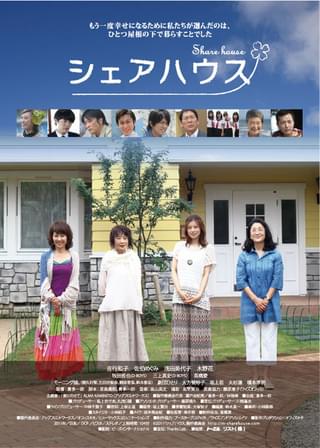
Set in a house overlooking the ocean in Shonan, this human drama follows four women of different generations—including a widow, a woman with a broken heart, and one struggling with her career—as they begin living together.
It beautifully illustrates how these women, each at a crossroads in life, rediscover themselves through the new lifestyle of a Share House. Sharing breakfast, listening to someone’s troubles, and celebrating small joys.
This film teaches us that a Share House is not just “cheap housing,” but a “choice” to enrich one’s life. The breezy Shonan atmosphere and the depiction of mindful living inspire many looking for a Share House in Japan with the thought, “I want to live like this.”
- Streaming Platforms: Amazon Prime Video
Terrace House: Closing Door

This theatrical release picks up directly after the final episode of the *Terrace House* TV series. Focusing on the series’ final and largest “graduation,” the film highlights the “farewell” as a significant milestone in Share House life.
Leaving a house filled with memories and stepping out into a new world. A Share House is often not a permanent home but a transit point in life; however, the intensive time spent there has a profound impact on one’s future.
The film captures the expressions people show for the camera and the inner conflicts of the residents with a scale befitting a movie.
-
- Streaming Platforms: Amazon Prime, U-NEXT, FOD
Manga & Anime: Sharing Dreams and Hobbies
Manga & Comics
4LDK

Haru Haruno (Hal), a young former actor whose dreams have been shattered, finds himself at a dead end in life when he is taken in by a certain share house. However, this is no ordinary home; it is inhabited by a group of handsome men with “complicated pasts”—each bearing a name related to the four seasons—and a single young girl.
His housemates are Natsuo, a meticulous and strict elite salesman; Akisada, a flirtatious talent scout who knows his way around women; and Touji, a mysterious, reclusive best-selling novelist. Furthermore, living alongside this all-male household is Ena, Touji’s young daughter.
The story unfolds as a heartwarming tale of child-rearing and communal living, centered around this peculiar setup of “four men and one girl.” Although they share no blood ties, these clumsy men—with their vastly different personalities and professions—gradually learn to cooperate through taking care of Ena and managing daily chores, fostering a bond that feels like a true “family.”
This is a moving human drama where each character faces their own past setbacks and personal struggles—such as lingering regrets over lost dreams, workplace pressures, and family feuds—while supporting one another on the path to emotional recovery. The series charms readers with the heartwarming daily lives of these handsome men as they struggle with unfamiliar parenting tasks, all set against the backdrop of the warm relationships unique to share house living.
- Amazon Link: 4LDK Vol. 1
Mr. Matsunaga in the Living Room

This age-gap romantic comedy follows high school student Miko Sonoda, who moves into a Share House managed by her uncle, and her interactions with the clumsy adults living there.
Specifically, Matsunaga-san, a 27-year-old designer, appears scary at first but cares for the residents more than anyone. The welcome parties he organizes and the casual interactions in the shared spaces represent the ideal “homey community” found in Japanese Share Houses.
The accidental encounters that occur through sharing a kitchen, bathroom, and living room create a unique proximity that is neither family nor just friendship. For readers who dream of finding romance in a Share House, this is a must-read.
- Amazon Link: Mr. Matsunaga in the Living Room Vol. 1
Takunomi.

Michiru Amatsuki moves to Tokyo for a career change and enters the women-only Share House “Stella House Haruno.” This “slice-of-life gourmet” work follows her as she enjoys delicious drinks with her housemates.
Each episode features a real-life beverage paired with snacks as the residents enjoy an evening drink in the living room. This symbolizes one of the happiest times brought about by the “shared kitchen and living room” in a Japanese Share House.
The peace of mind offered by a women-only property and the luxury of sharing a post-work drink with someone else are elegantly conveyed. It’s a lighthearted look at how choosing a Share House can alleviate the anxieties of starting a new life alone in the city.
The original manga has also been adapted into an anime.
- Streaming Platforms: Amazon Prime Video
- Amazon Link: Takunomi. Vol. 1