Hi there, I’m Miyuki! I’m a specialist share house blogger with over 10 years of experience living in share houses in Japan, having lived under the same roof with over 500 people, both international and Japanese. Let me ask you something: do you know what the number one “struggle” is for foreigners who have just started their life in Japan?
“I thought if I moved into a Japanese share house, it would be just like the TV show ‘Terrace House’—I’d make Japanese best friends and find romance immediately. But the reality? Everyone just says ‘Otsukaresama’ (Good work today) and heads straight to their rooms. It’s lonely.”
This is it. This is the most common complaint I hear.
Many international residents pay rent thinking they are buying “social interaction.” However, the reality of Japanese share houses is that there isn’t necessarily a party happening every single night.
“Are Japanese people cold?”
No, they are not. Let me assure you, it’s not that they aren’t interested in you, nor are they cold. They are simply “shy” and “waiting for the right moment.”
In this article, I’m going to thoroughly explain the “Complete Strategy for Making Japanese Best Friends in a Share House,” based on my years of experience. From how to choose a property to where to stand in the living room, and even a “magic action” you must do on your very first day. Read this, and your life in Japan is bound to change dramatically.
Utilizing the Ultimate Trick: “Connections”
First off, I’m going to share the “strongest shortcut.” If you fit these criteria, you might not even need to read the rest of this article.
Move into a house where a friend already lives
The easiest mode to start share house life is this: “Move into an empty room in a share house where a friend or acquaintance already lives.”
Why is this the strongest method?
Japanese culture still strongly holds the concept of “Uchi” (Inside) and “Soto” (Outside). For a complete stranger (Soto) to enter a community, you have to climb a high wall. However, just having a “letter of introduction” as a “friend of a member” treats you as someone close to “Uchi” right from the start.
Even if your friend isn’t Japanese, if they have already built relationships with Japanese friends in that share house community, getting them to introduce you is the best shortcut.
“Trust Transfer” Occurs
Japanese people place a huge emphasis on “trust.”
“This person is friends with [Name], so they must be a good person.”
In marketing terms, this psychological effect is called “Trust Transfer,” and it works powerfully in share houses.
By having a friend introduce you, you don’t need to go on a “self-introduction pilgrimage” from scratch. If your friend just adds, “This is my friend, and they’re studying Japanese,” the guard of the surrounding residents drops instantly.
What to do if you don’t know anyone
Most of you probably think, “I don’t have any Japanese friends like that!”
In that case, “shallow acquaintances” you are connected with on SNS (Instagram or Facebook) are fine. Look for a target.
Action Plan:
“Long time no see! Your share house looks fun. Let me know if a room opens up?”
Just send this message. Many share houses have a “Referral Discount,” offering benefits like rent discounts to the person introducing a new tenant. Since it becomes a Win-Win relationship, there is no need to hold back.
The Paradox of Property Selection (Houses with many Japanese people aren’t necessarily good)
If you don’t have connections, you’ll have to find a place on your own.
Here is a huge trap that 90% of foreigners fall into.
“I want Japanese friends, so I’ll choose a property where 90% of the residents are Japanese!”
This is the trap. If you do this, there is a high probability you will end up living a lonely share house life. Why?
Assess the “Attributes” of Japanese Residents
Japanese people living in share houses can be broadly divided into two types. Understanding this difference is everything when choosing a property.
Type A: The group seeking international exchange and cultural experiences
- Main Habitat: “International Exchange Share Houses” where the Japanese ratio is 50% or less.
- Characteristics: They have a clear motivation to speak English or experience foreign cultures. Even if there is a language barrier, they have the attitude to try and communicate.
- Attitude toward you: Deep down, they welcome you and want to be friends, but they are waiting for a trigger.
Type B: The group seeking cheap rent, location, and silence
- Main Habitat: Properties with a Japanese ratio of over 90%, or cheap small-scale properties.
- Characteristics: They live there because “they want Japanese friends,” “it’s just cheap,” or “there’s no key money/deposit.” They want to rest quietly when they get home and often aren’t looking to interact with strangers from other countries. Often, they can’t speak English or have no intention to.
- Attitude toward you: Indifferent, or in some cases, wary of you as an “outsider disrupting their living rhythm.”
The sweet spot is Japanese people living in “High Foreigner Ratio Properties”
It sounds paradoxical, but the correct answer to making Japanese friends is “choosing a property with a relatively high number of foreigners.”
Imagine this: A Japanese person who deliberately moves into a property where many foreigners live. They undoubtedly have an ulterior motive (in a good way) of “wanting to make foreign friends.”
They will patiently listen to your broken Japanese, and they are eager to teach you about Japan.
Important: When looking for a property, always ask this:
“What is the ratio of foreign residents?”
The foreigner ratio changes in real-time and is rarely listed on websites.
Since inquiring and waiting for an answer every time is a hassle, I recommend choosing a company that lists this data on their site.
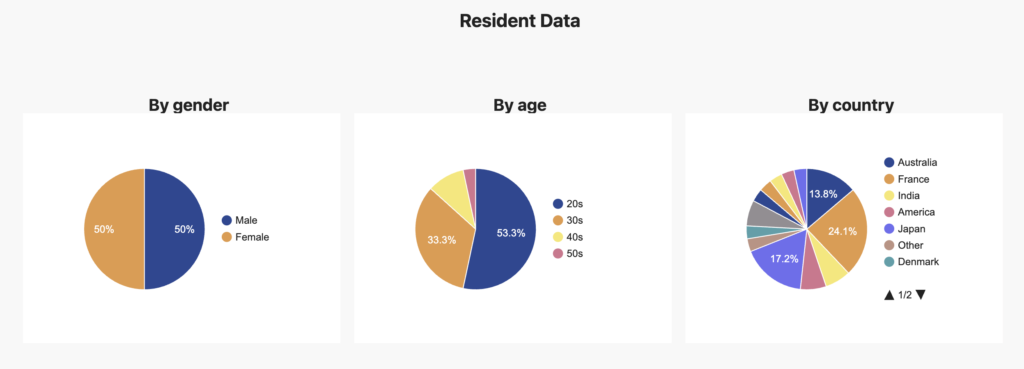
The image above is from a property by OakHouse, a company I used to live with.
They publish real-time data on the gender ratio, age, and nationalities for each property. Since they are a major company with many properties, I recommend checking them out at least once.
Even when choosing properties other than OakHouse, always check the Japanese resident ratio before moving in!
Post-Move-In “Bridge Strategy” and Utilizing Fellow Countrymen
Let’s say you successfully moved into a “property with Japanese people active in international exchange.”
However, don’t rush. Charging straight into a group of Japanese people is like challenging a boss at Level 1.
First, get “fellow countrymen” or “English-speaking foreigners” on your side
First, become friends with “senior foreign residents” who speak your language or are fluent in English.
They already understand the human relationships in the house and have connections with the Japanese groups.
Use the chain of “Introductions”
Once you become friends with a senior foreigner, ask them this:
“I want to make Japanese friends, who is easy to talk to?”
Then, go to the living room with that senior resident and have them introduce you to that Japanese person.
Japanese people are shy, but they are very open to “friends of foreigners they know.” By using this “Bridge,” you can enter the Japanese circle safely and smoothly.
He Who Controls the Living Room, Kitchen, and Smoking Area Controls the Share House
What you need to make Japanese friends in a share house isn’t “funny jokes.” It is “physical contact time (frequency of contact).”
Make maximum use of the psychological concept known as the “Mere Exposure Effect.”
Living rooms and kitchens have “Golden Times”
I don’t really recommend speaking to Japanese people you’ve never spoken to during the busy weekday mornings. While freelancers might have time, many Japanese people are workers and are pressed for time on weekday mornings.
The target times are “Dinner time (19:00–21:00)” and “Post-meal relax time (21:00–23:00).”
During these times, it is crucial to simply “stay” in the living room or kitchen.
However, there is one caution.
[Important] Do not sit there looking at your smartphone with earphones on.
People looking at smartphones with earphones are emitting a “don’t talk to me aura.” No one can approach you like that.
Read a book, study Japanese, or simply stare into space while drinking tea. Just this conveys an attitude of “it’s okay to talk to me.”
Personally, I also recommend making friends while cooking in the kitchen.
Many Japanese share houses use one large shared kitchen, like a large youth hostel. Since the physical distance is close, the kitchen is one of the easiest places in a Japanese share house to talk to Japanese strangers.
The Sanctuary Known as the “Smoking Area”
If you are a smoker, congratulations. You hold the “strongest passport.”
In Japanese society, the smoking area holds a unique community function.
Honest thoughts that are hard to speak in the living room can mysteriously be spoken in the closed room of a cramped smoking area. In Japan, we call this “Tabacco-mmunication.”
Recently, smokers feel a bit marginalized even in Japan, so there is a strange sense of solidarity among smokers, and you can become friends immediately with smokers in the same property.
“Do you have a light?”
“It’s cold today.”
Just this can often create a deeper bond than spending hours in the living room. If you are a smoker, please make full use of this sanctuary that non-smokers cannot enter.
One point to note is that “Electronic Cigarettes” (like Heated Tobacco Products), which are similar to VAPEs, are mainstream in Japan.
There are many people who like electronic cigarettes but dislike paper cigarettes because the smell sticks to their clothes, so don’t forget to be considerate there.
Techniques for Creating “Openings” to Break Psychological Barriers
From here, I will explain more specific “ways to start a conversation.”
This is where people from Western cultures are most bewildered.
Let’s look at the specific reactions when people who haven’t spoken to each other in the same property meet in the hallway or lobby.
West: “Hey, how are you?” → Conversation starts
Japan: “(Eye contact)… (Nod/Bow)… (Walks away)”
Why don’t Japanese people make eye contact? Why doesn’t the conversation continue beyond a greeting?
They believe they shouldn’t step into someone else’s territory unless they have a “Justification for conversation.”
“Pretending to be Troubled” is the Strongest Weapon
Japanese people will talk if there is a “reason.” And the “reason” Japanese people cannot ignore the most is “helping someone in trouble.”
You are a foreigner. Please make maximum use of the position of the “weaker party (entity that should be helped)” in Japan.
Even if you know, even if you understand, dare to “pretend not to know” or “pretend to be troubled.”
“Please Help Me” Phrase Collection by Target
[Laundry / Washing Machine]
Japanese washing machines have many buttons and are complex.
“Excuse me, I’m not sure how to use this… What does ‘Dry’ mean?”
[Kitchen / Trash Cans]
Japanese trash separation is said to be the most complex in the world.
“Excuse me, which bin is for plastic? Is it burnable?”
[Kanji / Japanese Language]
Show a food package or mail.
“Excuse me, I don’t know how to read this Kanji…”
There are almost no Japanese people who will ignore you when asked these things.
And importantly, once you establish a “helped / was helped” relationship, you rank up in the Japanese person’s brain from “unknown foreigner” to “Mr./Ms. XX who I helped the other day.”
Establishing this track record (flag) of “having spoken once” is the first and biggest hurdle in making Japanese friends.
The Strongest Method for Move-In Day: “Wi-Fi Password”
Among the “pretending to be troubled” tactics in the previous chapter, there is a killer move you can use within the first hour of moving in.
That is “Asking for the Wi-Fi password.”
You moved in today. You finished unpacking and go to the living room.
There are several Japanese people watching TV. It’s a tense moment.
Here, approach them with your smartphone in hand and a troubled look on your face.
You:
“Excuse me, do you know the Wi-Fi password? I can’t connect…”
Why is this the strongest move?
- 100% Response Rate: There is no resident already living there who doesn’t know where the Wi-Fi password is written. A conversation is guaranteed to happen.
- Physical Proximity: To input the password or look at the back of the router, physical distance naturally closes.
- Transition to Natural Self-Introduction:
“Oh, it connected! Thank you so much! I’m XX, I moved in today. Nice to meet you.”
This gives you a perfect start.
Even if the password is stuck largely on the wall, pretend you didn’t see it and dare to ask a human being. Because the goal isn’t to connect to the Wi-Fi, but to “connect with people.”
Exchanging “Words” to Deepen Relationships
Once you’ve created an opening and can greet each other, the next phase is deepening the relationship.
Strategy is needed here too.
Proposing Language Exchange
Once you get along to some extent, try proposing this:
“I want to get better at Japanese, so could you correct my Japanese sometimes? In exchange, I can teach you English (or your native language) anytime!”
Many Japanese people living in international exchange share houses want to learn English. This is a proposal with benefits for them too (Win-Win).
Making time to speak in each other’s languages for just 30 minutes once a week in the living room. If this becomes a routine, you are well on your way to becoming “best friends.”
Summary: Don’t Rush, Build Your “Place” Strategically
It got long, but here are the main points for making Japanese friends in a share house.
- Property Selection is 90%: Don’t choose a property that is completely Japanese only; choose a property with a “Foreigner Ratio of 30–50%” where Japanese people gather for exchange purposes.
- Use Connections: Enter the Japanese circle via introductions from friends or senior residents from your country.
- Contact Frequency: “Stay” in the living room or smoking area in the evening and create an atmosphere where it’s easy to talk to you (don’t look at your phone).
- Create Openings: Ask how to use “Wi-Fi” or “facilities” (pretend to be troubled) to give Japanese people a “reason for conversation.”
Once you become friends, Japanese people make very sincere and long-lasting friends.
The initial “wall that looks cold” is nothing more than simple shyness and cultural reserve.
If you knock on that wall with a little courage and the “strategy” in this article, the door will definitely open.
I am cheering from the bottom of my heart that your share house life in Japan will be filled with wonderful encounters!
Why not start by asking someone for the “Wi-Fi password” in the living room today?