The Ultimate Guide to Cleaning Rules for a Comfortable Share House Life in Japan
Starting a new life in Japan, especially living in a Share House, is incredibly appealing for cultural exchange and cost-saving. However, many international residents hit a major wall: cleaning.
The naive thought that “someone else will do it” can lead to serious interpersonal trouble in a Japanese Share House. In this article, from the perspective of a Japanese local with extensive experience in communal living, I will explain the reality of cleaning in Japan and the know-how to maintain stress-free, positive relationships through proper cleaning etiquette.
Why Do Cleaning Troubles Occur in Share Houses?
It’s no exaggeration to say that about 70% of Share House conflicts revolve around “cleaning, trash disposal, and noise.” Why is cleaning such a massive issue?
- Different Standards of Cleanliness: Generally, Japanese people are educated from a young age to clean public spaces “for the next person’s use.” In Japanese elementary, middle, and high schools, students themselves—not janitors—clean classrooms, hallways, and sometimes even toilets. Growing up in this environment creates a habit of tidying up shared spaces personally. On the other hand, this mindset is something that may not exist depending on one’s country, culture, or upbringing.
- The Unconscious “Free Rider”: If even one resident relies on the fact that others will clean and does nothing themselves, the frustration of the residents who clean diligently will eventually explode. I’ve seen this happen in a previous Share House I lived in—houses with such people face serious conflict and become “thorny” environments where it’s hard to feel comfortable.
- Vague Rules: Ambiguous rules like “clean when it gets dirty” are bound to fail because the definition of “dirty” varies from person to person.
How Management Styles Change the Cleaning Burden
The best way to resolve cleaning issues is decided at the stage of choosing your Share House. There are mainly three cleaning patterns in Japan, so it is crucial to choose a property with a cleaning burden you can personally tolerate.
“Full-Service Type” Where Management Dispatches Professional Cleaners
This is common in mid-to-large scale Share Houses and Social Apartments. Professional cleaners clean the common areas (kitchen, toilets, showers, living room) 2–3 times a week.
Pros: A constant level of cleanliness is maintained, and stress regarding cleaning rotations among residents is almost zero.
Cons: Management fees tend to be higher. Usually, the market rate is around ¥15,000 ($95) to ¥25,000 ($158) per month.
“Rotation Type” Where Residents Share Responsibilities
This is common in small-scale Share Houses of about 5–10 people. Roles like “Kitchen Duty” or “Toilet Duty” are decided on a weekly rotation.
Pros: Management fees are kept low, and a sense of solidarity is fostered among residents. It often costs around ¥5,000 ($32) to ¥10,000 ($63) per month.
Cons: In almost every property, someone will eventually slack off. Since the standard for “being clean” differs by person, it can become a source of interpersonal trouble and cause mental stress if it doesn’t meet your standards.
“Self-Cleaning Type” Where Users Clean on the Spot
This operates on the “Honor System,” with no professional cleaners and no fixed rotation. The rule is simply “wash what you use immediately, wipe what you dirty.”
Caution: This type is the most affordable, but since it relies entirely on the residents’ morals, you need to strictly check the “current state of cleanliness” during your viewing.
Japanese “Cleaning Common Sense” and Etiquette That Confuses Foreigners
Living in a Share House in Japan involves several points that differ significantly from Share Houses abroad. If you don’t know these, you might be labeled as “having bad manners” even without bad intentions.
Clean Up Your Own Dishes and Cookware Immediately After Use
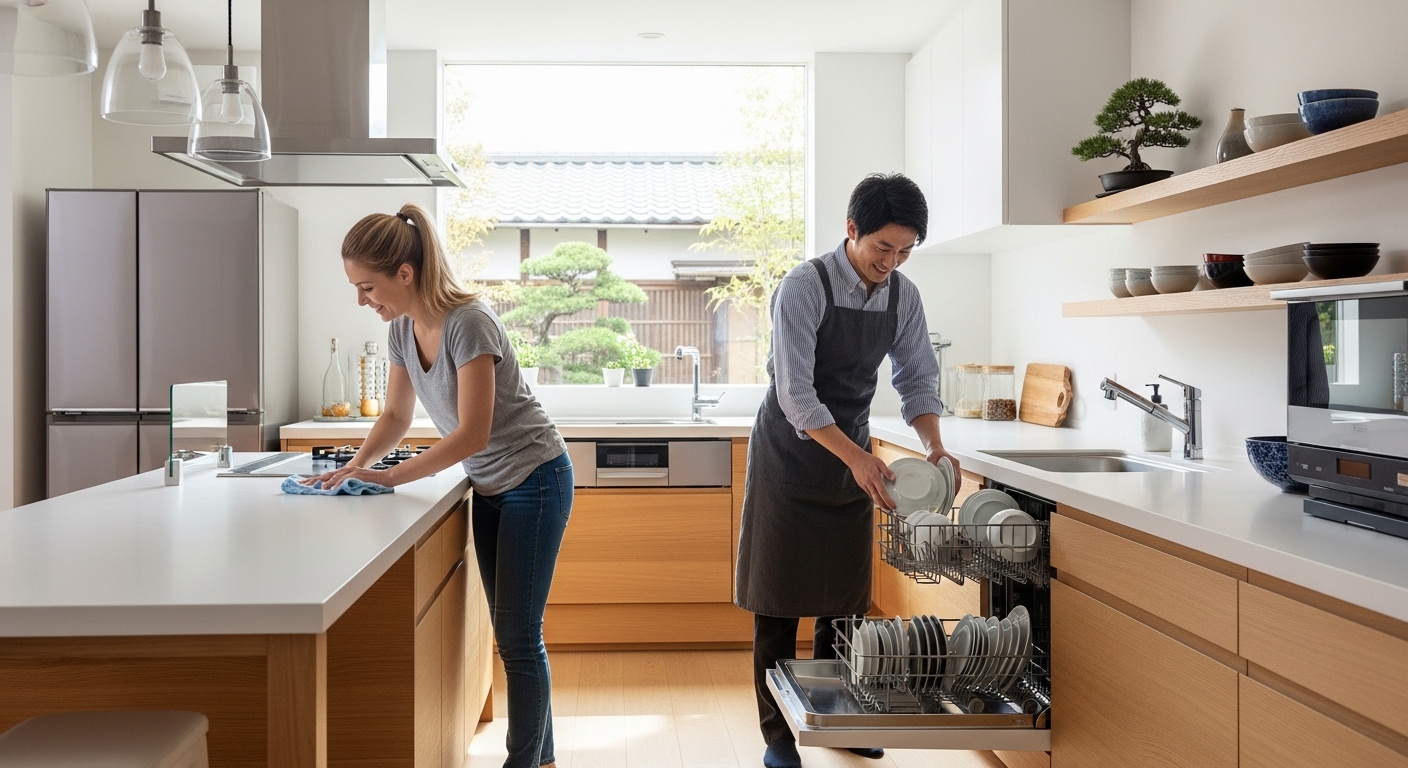
As mentioned before, even in Full-Service types, you must wash your own dishes. Since the kitchen gets crowded during dinner time, try to wash your pans and pots immediately after cooking, before you sit down to eat. That way, while you are eating, the next person can use those tools to prepare their meal.
Handling Oil Stains and Drains Around the Kitchen
In Japan, pouring cooking oil or fat from meat directly down the drain is extremely frowned upon. This is for structural reasons; most Japanese kitchens do not have garbage disposals, and the sink is connected directly to the piping. If you pour oil into the sink, it cools and solidifies inside the pipes, causing clogs.
Imagine the white, solidified fat you’ve seen on a pan after cooking—imagine that happening and building up inside the sewer pipes. To prevent this, wipe off oil from pans with paper towels or newspaper and always dispose of it in the “burnable trash.” Also, if you know you’ll produce a lot of oil (like when deep-frying), using items like the one below will solidify the oil on the spot so you can toss the block into the burnable trash.

Japan’s Unique and Detailed Trash Sorting Rules
This is the ultimate hurdle. In Japan, you must separate trash into categories like burnable, non-burnable, plastic, glass bottles, cans, and PET bottles. It’s a headache even for Japanese people. In a Share House, if even one person breaks the rules, the trash may not be collected from the station.
Depending on the area, removing the caps and labels from PET bottles is also mandatory. In Tokyo, sorting is often lenient because the incinerators are high-spec, but in regional areas, sorting is still very strict. Be sure to follow the local rules of your area.
Noise Troubles with Vacuums and Washing Machines Late at Night or Early Morning
Since Japanese housing often has thin walls, the hours for using vacuums or washing machines are strictly limited. Generally, 8:00 AM to 9:00 PM is the acceptable range. Starting a vacuum or using the laundry at midnight will inconvenience your housemates, so make sure to do these tasks during the day or shortly after returning home before it gets too late.
What Happens if You Skip Your Cleaning Duty? The Reality of Penalties
To make cleaning rules effective, many non-Full-Service Share Houses have penalties in place.
- Posting in Common Spaces: If you forget your duty, your name may be mentioned on a whiteboard or in a group chat (LINE or Slack). This can be quite a bit of psychological pressure.
- Collection of Fines: Depending on how many times you skip, you might be charged around ¥3,000 ($19) as a cleaning proxy fee.
- Refusal of Contract Renewal: If you neglect cleaning too much and complaints from other residents don’t stop, the management company may judge you as “unfit for communal living” and refuse to renew your contract (essentially an eviction notice).
Smart Property Selection to Zero Out Cleaning Stress
Whether your Share House life is comfortable or not is actually 80% decided during the “Viewing” before you move in. Here is a checklist to identify a “winning property” where cleaning is well-maintained.
Check the “Notices” and “Bathroom Corners” During the Viewing
Don’t be fooled by a quick glance during the viewing. Whether management is truly diligent shows in these “hidden spots”:
- Bathroom Corners and Caulking: Are red or black mold being left untreated? Grime in water areas leads directly to resident stress.
- Contents of the Bulletin Board: A property with many angry signs saying “Please Clean Up!” is a sign that troubles are currently occurring.
Popular Share House Brands Known for Good Management
If you strongly wish “not to fight with housemates over cleaning,” the shortcut is to choose a property managed by a major operator from the start. For example, the following brands have a reputation for their cleaning systems:
- Oakhouse: I lived there too, and since almost all properties use a Full-Service cleaning system, I never felt stress regarding cleaning. Also, their unique management system makes the cleaning status visible.
- Social Apartment: Professional cleaning several times a week is standard equipment, maintaining a hotel-like cleanliness.
These properties generally charge a contract fee of about ¥30,000 ($189) to ¥50,000 ($316), but it is a cheap investment if you consider that you are buying your way out of cleaning stress.
Summary: A Clean Environment Smooths Out Share House Relationships
Cleaning in a Japanese Share House is not just a chore; it is an “expression of respect for your housemates.” An investment of about ¥1,000 ($6) in cleaning supplies or a little extra checking before moving in will make your life in Japan surprisingly comfortable.
I hope this article helps you find the perfect, clean, and cozy Share House!