For many dreaming of a new life in Japan, the biggest source of anxiety is often “the language barrier.” You might be wondering: “If I can’t speak a word of Japanese, will I end up isolated in a share house community?” or “Will I cause trouble because I can’t understand the house rules?”
As a professional who knows the ins and outs of the share house scene across Japan, I’m here to give you the real talk, no filters. Let’s start with the conclusion: Even with zero Japanese skills, living in a share house is 100% possible.
However, there is a big difference between simply “surviving” and achieving the “fulfilling Japanese life” or “language improvement” you’re likely hoping for. Today, I’m going to pull back the curtain on the linguistic reality of share houses—something many agents won’t tell you.
The Truth: 90% of Foreign Residents Only Know Basic Greetings
First, let me put your mind at ease. Based on my experience moving through six different share houses in Japan, about 90% of international residents speak only “survival Japanese”—words like “Konnichiwa,” “Arigato,” and “Oishii”—when they first move in.
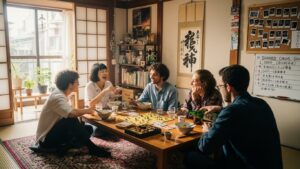
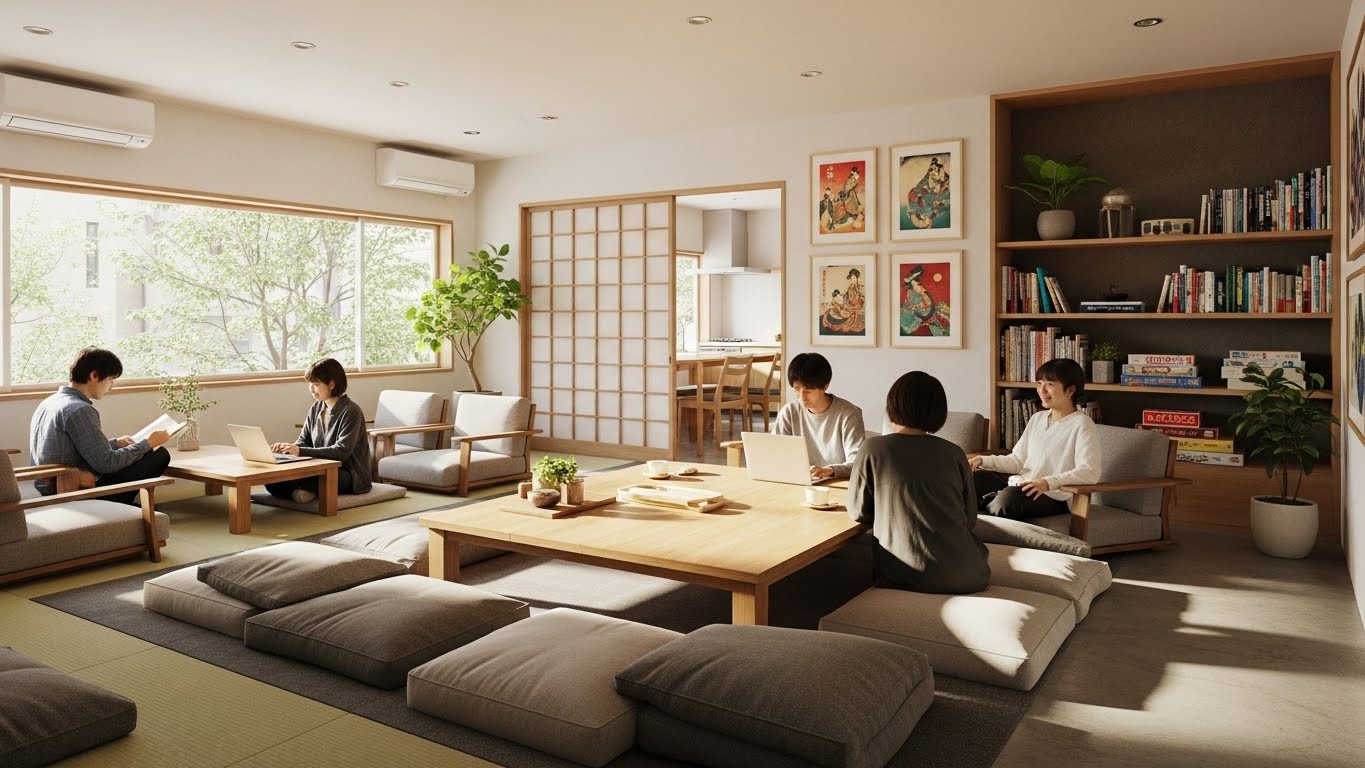
The fear that “I’ll be the only one who can’t speak it” is completely unfounded. Just look around a typical share house lounge; you’ll see a mix of broken Japanese, enthusiastic English, and people pointing at translation apps on their phones. That is the “normal” scenery of a Japanese share house.
Why doesn’t life fall apart with zero Japanese? Here are three main reasons:
- Professional Management: Almost all staff at companies actively welcoming foreigners are English-fluent. From multilingual contracts to explaining how to use appliances or take out the trash, everything is set up to work in English.
- The Japanese Residents’ Motivation: Many Japanese people move into these houses specifically because they *want* to speak English or make international friends. To them, your lack of Japanese isn’t a flaw—it’s a perfect opportunity for them to practice their English!
- Evolution of Digital Tools: We live in the age of DeepL and Google Translate. Whether it’s a minor house rule or a deep late-night discussion, you can handle it all with just a smartphone.
In short, Japanese is no longer a mandatory “infrastructure” for daily life. However, if you are thinking, “I want to improve my Japanese even a little while I’m here,” then pay attention. If you make a mistake in how you choose your property, you might find yourself heading home a year later having spoken nothing but English.
If You Want to Improve, Look at the “Resident Demographics”
It’s a myth that you’ll learn Japanese at just any “International Exchange” share house. Every property has an unofficial “common language” that is structurally determined by the nationalities and, more importantly, the “career paths” of the residents.
The Western Resident Trap: The Common Language is “English”
Houses where the majority of residents are from the US, UK, Canada, Australia, or Europe may look stylish and fun, but they aren’t always the best choice for learning Japanese. This is due to their typical backgrounds:
- Unique Work Environments: Many are expats at foreign firms, engineers, or remote workers. In their offices, English is often the primary language, and even their Japanese colleagues speak to them in English. They are in an environment where they can earn a high salary without ever mastering the local tongue.
- Community Dynamics: In environments with many Westerners, English speakers tend to dominate the conversation, even if Japanese residents are present. The Japanese residents will often try to keep up in English, creating a 24/7 English-immersion environment for anyone who wants it.
The common Western resident’s lament—”I’m in Japan, but I didn’t say a single Japanese word today”—happens because they are in an environment where there is zero *necessity* to speak it.
・People with no interest in learning Japanese.
・People who want to communicate primarily in English.
・People who want to learn Japanese.
・People who want to interact with a wide variety of cultures since they’ve come all this way.
The Real Value of Asian-Majority Houses: The Common Language is “Japanese”
On the flip side, properties with many residents from China, Korea, Taiwan, Vietnam, or Nepal are often the ultimate Japanese training grounds. In my experience, Asian residents in share houses tend to see their Japanese skills skyrocket during their stay. This is due to their “positioning” in Japanese society:
- Commitment to Local Companies: Many are employed by local Japanese firms or are attending vocational schools and universities to get there. For them, Japanese isn’t a “hobby”—it’s a “weapon” tied directly to their employment, salary, and visa. Their level of desperation is different.
- Japanese as a Bridge Language: For example, if a Korean resident and a Vietnamese resident want to talk, they can’t use their native languages. If they aren’t fluent in English, their only bridge for communication is the “Japanese” they are currently working so hard to learn.
As a result, the lounges in these houses are filled all day with passionate, albeit sometimes halting, Japanese. By placing yourself here, your Japanese is forced to level up. This isn’t about nationality; it’s the “structural reality” of the share house industry.
・People who seriously want to learn Japanese.
・People who don’t speak English and have no current need to learn it.
・People with zero interest in learning Japanese.
・People who want to communicate or study in English.
Minimum Prep to Shine in a “Japanese-Base” House
If you decide to go with a Japanese-based house (like those with many Asian residents), your next step is pre-arrival prep. My advice? Throw perfectionism out the window.
You do NOT need to practice reading or writing Japanese (Hiragana, Katakana, or Kanji) at all.
Thanks to traditional schooling, many people start with memorizing characters. In a share house community, that is a waste of time. A share house is a place for “communication,” not a “study hall.” Between the different alphabets and thousands of Kanji, the “learning cost” of reading and writing is so high that most people give up.
All You Need is “Speaking”
If you’re moving into an Asian-majority house, simply master “minimum daily conversation” orally.
“Ohayou” (Good morning), “Otsukaresama” (Good job/Hi), “Itadakimasu” (Let’s eat), “Namae wa?” (What’s your name?).
That’s enough. Even if you can’t read a single character, if you can look someone in the eye and say these phrases, you’ll be accepted as part of the community immediately. Your neighbors won’t laugh at your grammar mistakes—they are fellow warriors fighting the same battle with the Japanese language. If you have 100 hours to practice writing, spend it on YouTube listening and speaking drills instead.
Summary: Your “Choice” Makes the Environment Work for You
To reiterate: you will be welcomed into a Japanese share house even with zero Japanese skills. 90% of those who came before you were in the same boat.
However, if you want to use “language” as a key to enjoy your life in Japan more deeply and freely, keep these two things in mind:
- Choose a property with many Asian residents where Japanese is likely to be the common language.
- Forget reading and writing for now; just master “minimum speaking” before you move in.
It’s okay if you can’t read or if your grammar isn’t perfect. The ability to laugh and say “Otsukaresama!” in the lounge will be your greatest asset in your new Japanese life.
If you’re wondering, “Wouldn’t a share house with only Japanese people be the best then?” check out the article below. You’ll see why I specifically recommend “International houses with many Asian residents.”